|
1. What is this DNA test all about?
2. Will a DNA test tell me who my ancestors are? What will the test tell me?
3. Why do we analyze the Y chromosome?
4. What is analyzed?
5. Exactly what does a Y chromosome match demonstrate?
6. Does a Y chromosome match prove this relationship?
7. What is the advantage of the 25 marker test over the 12 marker test?
8. Do Y chromosome analyses sometimes match, but not at every point?
9. If no Y chromosome match is found, what does that show?
10. My maiden name is BLAIR and I would love to have this information, but I am female
and have no brothers and my father has passed on now. There are no living males with surname BLAIR in my family,
only male cousins named BLAIR, some quite distantly related.
11. My line split off from the BLAIR family two hundred years ago.
My ggg-grandmother was a BLAIR. I do research on my BLAIR ancestors but have no close BLAIR relatives.
12. Why are you excluding women? We are the children of our BLAIR ancestors as much
as the men.
13. There is only one living male person surname BLAIR in my family. Is there any point
joining the study if I don�t have two or three family members who are BLAIR surname males?
14. I was adopted by BLAIRs as a child. Is there any benefit to do a DNA test?
15. My male BLAIR cousins don�t care a thing about family history. They won�t pay
for this.
16. I already know my BLAIR family comes from somewhere in Ireland. What are we
going to learn from doing this that is new?
17. All it takes is one break a long time ago and you won�t be able to match up a whole
line of BLAIRs. You will never be able to put all the BLAIRs together.
18. How is the DNA sample obtained?
19. How do I participate?
20. How will my DNA information be used?
21. How will my DNA information be protected?
22. I noticed my DNA markers match those of several other participants. Is there anyway
I can contact them?
23. Couldn�t it be embarrassing if an individual�s Y chromosome does not match when it should?
24. My test results do not match any others, does that mean I'm not a BLAIR?
Q1. What is this DNA test all about?
A. There are two types of DNA tests now available for genealogical testing: the Y-chromosome (Y-DNA) test and the
mitochondrial (mtDNA) test. A direct female line can be traced by testing mitochondrial DNA. However, since we are presently
interested in tracing surnames, which are usually passed from father to son, the testing of the Y-chromosome DNA is what
we are interested in. For more information on DNA and Y-chromosome testing see DNA 101.
Top
Q2. Will a DNA test tell me who my ancestors are? What will the test tell me?
A. No, a DNA test will NOT tell you who your ancestors are. The test
WILL tell if two or more participants share a common
ancestor, and give you a probability of the number of generations to the
The Most Recent
Common Ancestor (TMRCA).
Top
Q3. Why do we analyze the Y chromosome?
A. The Y chromosome is the only chromosome passed unchanged from father to son, and therefore indicates the paternal line
of descent. All males in a patriarchal line have the same Y chromosome. The Y chromosome is not present in females.
For more information on DNA and Y-chromosome testing see DNA 101.
Top
Q4. What is analyzed?
A. We look at specific parts of the Y chromosome to obtain a �signature�. Two or more males whose Y chromosome signatures
match come from the same paternal line of descent. Those whose signatures do not match are from different lines. For more
information on DNA and Y-chromosome testing see DNA 101.
Top
Q5. Exactly what does a Y chromosome match demonstrate?
A. A Y chromosome match shows that two males have a common male ancestor. This ancestor could be their father, or it could be a
male from a thousand years ago. For more information on DNA and Y-chromosome testing see DNA 101.
Top
Q6. Does a Y chromosome match prove this relationship?
A. Although no evidence is ever absolutely certain, the confidence level for such a match is very high. Typically, there
is less than one chance in a million or more that the demonstrated relationship is in error. For more information on
DNA and Y-chromosome testing see DNA 101.
Top
Q7. What is the advantage of the 25 marker test over the 12 marker test?
A. More markers reduce the number of generations to the
The Most Recent
Common Ancestor (TMRCA).
If you match someone on 12 out of 12 markers you almost certainly share a common ancestor. The
question becomes "how far back do you have to go before you find that common ancestor?"
If all 12 markers match there is a 50% probability that TMRCA is 14 generations
or less, a 90% probability that TMRCA is 48 generations or less, and a 95% probability that TRMCA is 62
generations or less. For 12 identical markers, 95% of the possible TRMCA values fall between 1 and 77 generations.
If all 25 markers match there is a 50% probability that TMRCA is 7 generations or less,
a 90% probability that TMRCA is 20 generations or less, and a 95% probability that TRMCA is 30 generations or less.
For 25 identical markers, 95% of the possible TRMCA values fall between 1 and 44 generations.
Top
Q8. Do Y chromosome analyses sometimes match, but not at every point?
A. Yes. Over a period of many years, a small number of mutations can be counted on to appear, so there may be one or more points
where the Y chromosome analysis does not match exactly. For more information on DNA and Y-chromosome testing see DNA 101.
Top
Q9. If no Y chromosome match is found, what does that show?
A. It demonstrates to a very high degree of probability that the two males analyzed do not share a male ancestor. Although this
is true for the two individuals tested, it may not be true for the family groups of the individuals who were tested, because
there are a number of sources of �non-paternal events�.
Top
Q10. My maiden name is BLAIR and I would love to have this information, but I am female and have no brothers
and my father has passed on now. There are no living males with surname BLAIR in my family, only male cousins named BLAIR,
some quite distantly related.
A. Your male cousins probably have the same Y-DNA as your father and his male ancestors with surname BLAIR. Testing
your cousins is the same as testing your late father if they are the natural children of your BLAIR ancestors. That is because
the Y chromosome passes unchanged from father to son apart from random mutations. So if your father and your cousins have any known
common ancestor, even back to your 4th great grandfather or beyond, the DNA sample should be the same as testing your
father, give or take a mutation or two.
Top
Q11. My line split off from the BLAIR family two hundred years ago.
My ggg-grandmother was a BLAIR. I do research on my BLAIR ancestors but have no close BLAIR relatives.
A. If you know or can find male surname descendents of your gggg grandfather BLAIR, you can in effect �test� him by testing
his descendents. That is because the Y-DNA is passed on without change from father to son. If you test a couple of your BLAIR
cousins and they match, you can say with high confidence that their Y-DNA is very close to the Y-DNA of your gggg grandfather.
Then you can compare his sample to other samples in the study and possibly learn much new information about his line for your
research.
Top
Q12. Why are you excluding women? We are the children of our BLAIR ancestors as much as the men.
A. We cannot test females for the Y chromosome because they do not have one, only males. The technology does not exist to
trace BLAIR surname ancestors through their female descendents, at least not yet. The reason requires going into a bit too much
explanation of basic genetics, but essentially we get a blend of genes from our fathers and mothers for everything except the Y
chromosome, which passes mostly unchanged from father to son. Most other genes combine, thus making every individual unique
with a unique genetic signature. But that does not mean that daughters are not just as related to their fathers as sons. In
fact everyone has genes from all their ancestors, half from each parent, a quarter from each grandparent, an eighth from each
great grandparent and so forth back forever. Every gene in our DNA existed in some ancestor 10,000 years ago apart from a few
mutations possibly. By using Y-DNA analysis women can learn much valuable information about their BLAIR ancestors, the same as
male descendents. There are tests of mtDNA that trace female lineages, but they are not useful for single surname studies.
Top
Q13. There is only one living male person surname BLAIR in my family.
Is there any point joining the study if I don�t have two or three family members who are BLAIR surname males?
A. Yes, there is potential value for you to join the study. The reason for testing two or three distantly related cousins is
that this �validates� the family at least back to the known common ancestor. A single test could provide incorrect data for
the family if there is an unknown adoption or a false paternity somewhere back in the past. If you alone take the test and it
matches others in the study, you will have learned that your branch of the BLAIR family is related to theirs, with little
doubt. If it does not match and you cannot find any cousin to test to validate the result, at least your sample will sit there
in the database until sometime in the future a match is secured.
Top
Q14. I was adopted by BLAIRs as a child. Is there any benefit to do a DNA test?
A. That depends on whether you are trying to trace your "biological" family or your BLAIR family. If you're trying
to trace your "biological" family you would have your own DNA sample tested. If you already know the surname of your
"biological" family, it would probably be best to try to find a DNA project for that name since your results would more
likely match someone in that group than the BLAIR group.
If you're interested in tracing your BLAIR family roots you would need a DNA sample from your BLAIR
father or other male BLAIR family member.
Top
Q15. My male BLAIR cousins don�t care a thing about family history. They won�t pay for this.
A. There is no rule that says the person ordering and paying for the test must be the person being tested. If your cousins will
consent to doing this simple, painless test, you can order the kits on line and then send them to your cousins, and return them
with your own payment. Some of the other family reconstruction projects have multiple researchers in the same family line that
have split the cost of testing male cousins who have no interest in our hobby.
Top
Q16. I already know my BLAIR family comes from somewhere in Ireland. What are we going to learn
from doing this that is new?
A. First of all, you may discover many BLAIR families that are your cousins that you did not know about before. They may have
new information and family histories that will be useful to you, and you will know they are your relatives with little or no
doubt. A couple of families named BLAIR side by side in the census could be brothers, or could be coincidence. But DNA is
proof. Second, as the study expands over time, you may discover the exact village where your ancestors came from in Ireland,
possibly even Church records that take you back hundreds of years.
You may also discover that you share the same markers with BLAIRs who come from Scotland. There are people
who believe that the BLAIRs who came from Ireland originated in Scotland but for many who have gotten back to Ireland they are
not able to make a Scotland connection. DNA testing might make this connection.
Top
Q17. All it takes is one break a long time ago and you won�t be able to match up a whole line of BLAIRs.
You will never be able to put all the BLAIRs together.
A. That is very likely true, but the purpose of this is to help different BLAIR families link up to further their genealogical
research. Even if long ago a Mr. BLAIR adopted a boy whose natural father was Mr. JOHNSON, all his male descendents will still
be with a common ancestor, which may prove useful. Also, if someday a JOHNSON has a test done, we may find that match as well!
Top
Q18. How is the DNA sample obtained?
A. DNA can be obtained from any cell, but one of the easiest samples is obtained by swabbing the inside of the cheek with a
sterile cotton swab.
Top
Q19. How do I participate?
A. Details on how to participate will be provided if the BLAIR DNA Project gets off the drawing board. Basically each
participant will fill out an Application Form and a Pedigree Chart which will be sent to the Family Coordinator. The Family
Coordinator will assign each participant a unique Participant ID# and send the participant a DNA sample kit. The participant
will take his own DNA and return it to the Family Coordinator along with a check payable to the Testing Lab. The Family
Coordinator will forward the DNA to the Testing Lab. Results will be returned to the Family Coordinator who will forward them
on to the participant.
Top
Q20. How will my DNA information be used?
A. This poses a declicate balance between making the information available to others while protecting the privacy of the
participants. DNA test results are of little use on there own. Their value is how they compare to other test results and who
they match. Most other surname DNA projects display test results on a website as shown below:
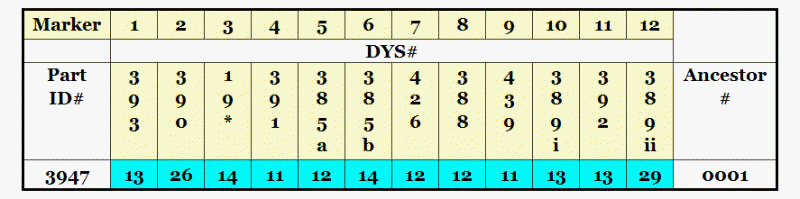
The numbers (1-12) across the top of the table are the
marker numbers. They have no significance other
than as an easy way to refer to the marker. Note: FamilyTree DNA refers to these numbers as Locus. The second set of numbers
across the top of the matrix are DYS# (the actual marker names).
The numbers down the left side of the table identify the participant in the DNA project.
The numbers down the right side of the table identify the participant's oldest known ancestor.
The rest of the numbers are the Allele
(the number repeats) for each participant at the specified marker.
Note that there is nothing to identify participants other than the participant number.
Top
Q21. How will my DNA information be protected?
A. Only the participant providing a DNA sample and the Family Coordinator will know what his results are (unless they
decide they would like to share that information - see next question). All samples and identifying information will be
received by the and will be assigned an identifying number. This ID number will be the only identifying information
anyone else sees, so no one other than the coordinator will know who participates in the study or which result is from
which person. The portion of the DNA tested gives a distinctive "signature" for a lineage rather than for
an individual, so there is no risk of this data being of any use to anyone for personal identity.
Top
Q22. I noticed my DNA markers match those of several other participants. Is there anyway I can contact them?
A. If the participant chooses not to identify himself, you can contact the Family Coordinator who will forward your
request on to the participant.
Top
Q23. Couldn�t it be embarrassing if an individual�s Y chromosome does not match when it should?
A. Yes, and for this reason no participant's results will ever be revealed except by a code. Names of participants will not be
published or released unless the participant give his WRITTEN permission to do so.
Top
Q24. My test results do not match any others, does that mean I'm not a BLAIR?
A. There is always a possibility that you could get disappointing test results. Samples that vary by three or more markers
from the main group may do so for a number of reasons. One possibility is that they represent distinct lines either older
or younger than the currently observed most frequent line. Another is that there has been a �non-paternal event� at an
unknown past time. There are several possible types of non-paternal event in addition to a pregnancy gained outside of a
marriage. For example, a child may be adopted and given the BLAIR name; a man may take the BLAIR name when he marries a
BLAIR daughter; a BLAIR man may marry a pregnant woman whose husband has died; a couple where the wife is the BLAIR may
choose to give their children the BLAIR name for various reasons; clerical error in recording administrative data may assign
a BLAIR name to the wrong person, and so on.
It should be stressed that adoptions were quite common in every age (ie. parents died by disease or war
and a relative took in the children and raised them with their name; or young daughters had a child out of wedlock and the
parents raised it as their own).
Some may not want to see a result indicating a non paternity event but we are all legal BLAIRs and a small
sample size could be misleading. One may get a DNA sequence which suggests a non paternity event but they could be of the
original blood BLAIR line. Let me explain. Twenty people are tested and 19 are very similar but the last is clearly different.
It could turn out that the 19 descend from the same person 300 years ago and this person was an adopted BLAIR while the other
is of the original blood line going back 800 years.
Top
|